Robotics, AGI and agentic AI: where the digital agent meets the physical world
Software agents get a retry button. Robots get a broken glass and an incident report. That single asymmetry explains most of the gap between what agentic AI can do on a screen and what it can do in a kitchen.
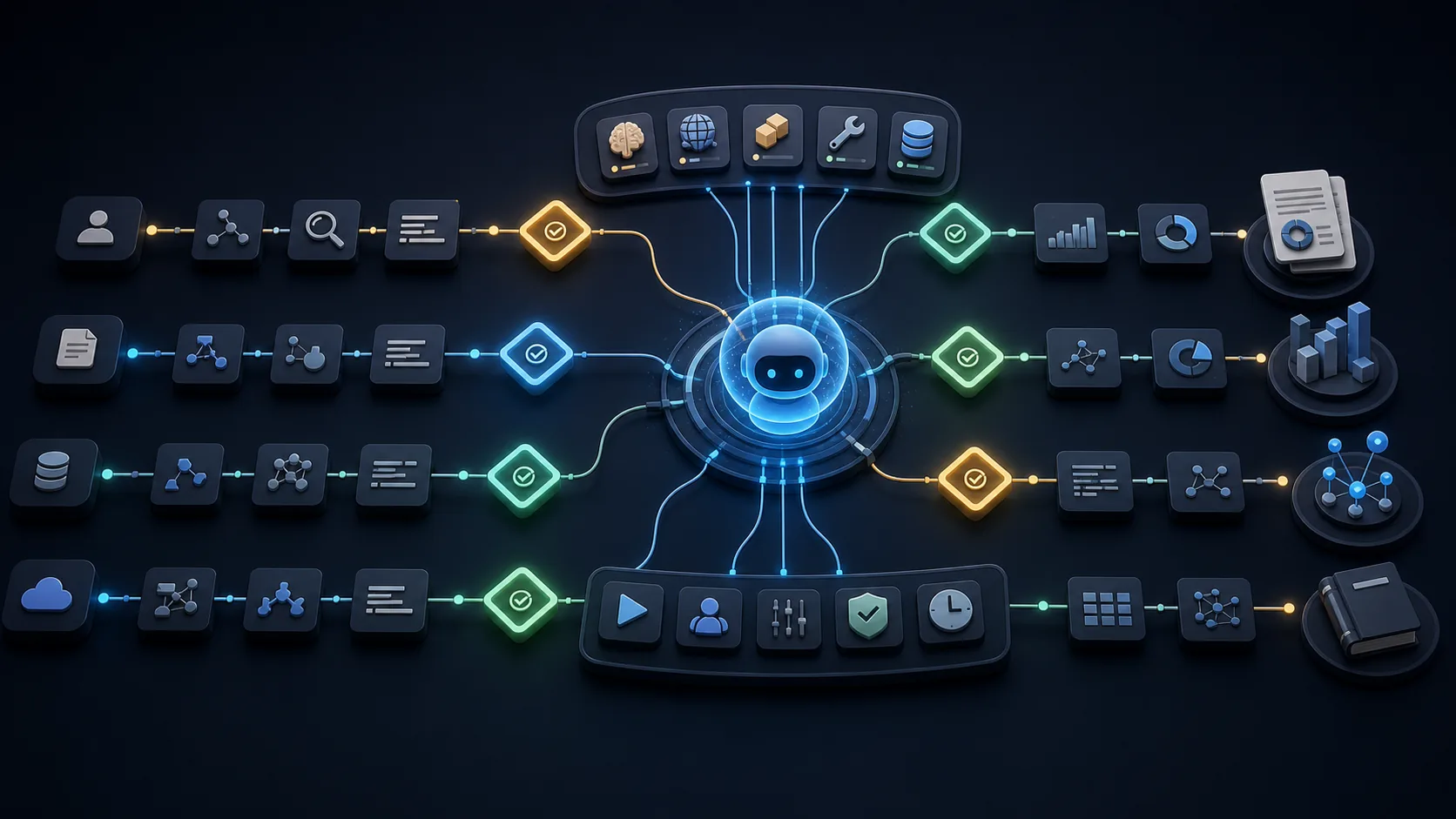
Robotics is where claims about general intelligence get tested against physics. The last few years produced a genuine shift: vision-language-action models trained on web-scale data plus robot demonstrations can now generalise to objects and instructions never seen in training, and cross-embodiment datasets have shown that a policy trained on many robot types transfers better than one trained on a single platform. What has not changed is the data asymmetry—text is abundant and free, robot experience is scarce, expensive and slow to collect—and the consequence asymmetry, since a failed physical action cannot be undone with a retry. The realistic near-term picture is generalist policies handling short-horizon manipulation in semi-structured environments, supervised by people, with an agentic software layer doing planning, scheduling and exception handling above them. Full embodied generality remains an open research problem, and safety standards, not model quality, gate most deployments.
The paradox that keeps winning
Robotics has a long tradition of humbling AI predictions, and the reason is structural. The cognitive tasks humans find hard — chess, calculus, legal analysis — turned out to be comparatively tractable. The sensorimotor tasks a toddler performs without conscious effort — picking up a slightly slippery mug, noticing the floor is wet, adjusting grip when something shifts — turned out to be extraordinarily hard. Two billion years of evolutionary optimisation went into the second category and about ten thousand years into the first.
This is why a system that can pass professional examinations may still fail to load a dishwasher. It is not a scandal or evidence of fakery; it is the expected result of the paradox. Anyone reasoning about AGI timelines who has not internalised it will consistently over-predict physical capability and under-predict cognitive capability, in the same breath.
The corollary matters for planning. Progress in embodied AI is gated by things that do not respond to more parameters: contact physics, sensing noise, mechanical reliability, calibration drift, and the sheer cost of collecting experience in a world that runs at one second per second.
What actually changed: vision-language-action models
The substantive shift came from applying the foundation-model recipe to robot control. RT-1 demonstrated that a transformer trained on a large, diverse set of real robot demonstrations could perform many tasks and generalise better than task-specific policies.[1] RT-2 went further by co-training on web vision-language data alongside robot trajectories, producing a policy that inherited semantic knowledge from the internet — it could act on concepts it had never been shown in a robot demonstration, because it had read about them.[2]
The Open X-Embodiment effort then attacked the data problem collectively, pooling demonstrations across many robot types and labs and showing that a policy trained across embodiments outperformed policies trained on any single one.[3] That result is more important than it sounds: it means robot data is partially fungible across hardware, which turns a fragmented collection problem into a shared one.
Since then, generalist policies have become a category rather than a research curiosity. Physical Intelligence’s flow-matching approach targets dexterous, high-frequency control across platforms,[4] and Google DeepMind’s robotics models are explicit attempts to carry a large multimodal model’s world understanding into physical action.[5] The through-line is the same in every case: semantic generality comes from the language-vision side, and physical competence still comes from robot data that somebody had to collect.
| Development | Core contribution | What it generalised | What it did not solve |
|---|---|---|---|
| RT-1 | Transformer policy on diverse real demonstrations | Across tasks on one platform | Cross-embodiment transfer |
| RT-2 | Co-training on web data plus robot data | Semantic concepts unseen in robot data | Fine dexterity and long horizons |
| Open X-Embodiment | Pooled cross-robot dataset and policy | Across hardware platforms | The absolute scarcity of robot data |
| Flow-based generalist policies | High-frequency dexterous control | Across platforms and tasks | Reliability at industrial standards |
| Multimodal robotics models | World understanding carried into action | Instruction following in novel settings | Guarantees, verification, long autonomy |
The data problem is not the same problem
Language models were built on a corpus that already existed and cost nothing to create. Robotics has no such corpus. Every trajectory in a robot dataset was produced by a real machine, in real time, usually with a human teleoperating it, and frequently with a technician resetting the scene between attempts. The unit economics of data collection are the central fact of the field, and they are why simulation, teleoperation fleets and cross-embodiment pooling all get so much attention.
Simulation helps and does not solve it. Rigid-body dynamics, rendering and kinematics simulate well; deformable objects, granular materials, friction at contact, cable routing and anything wet simulate badly. The resulting sim-to-real gap is not uniform — it is concentrated exactly in the manipulation problems that matter for household and service work, which is a cruel arrangement.
Internet video is the obvious untapped reservoir and an active research direction, but it comes without actions, forces or proprioception. You can watch a million videos of someone chopping an onion and learn a great deal about what chopping looks like and nothing reliable about how hard to press.
| Data source | Volume | Cost per hour | Fidelity to real control | Main limitation |
|---|---|---|---|---|
| Web text and images | Enormous | Effectively zero | Semantic only | No actions or forces |
| Internet video | Very large | Near zero | Observational | No action labels or proprioception |
| Simulation | Large | Low | Good for rigid, poor for contact | Sim-to-real gap where it matters most |
| Teleoperation | Small | High | Direct | Human time is the bottleneck |
| Autonomous real-world collection | Small | Very high | Direct | Failures cost hardware and safety |
| Cross-embodiment pooling | Growing | Shared | Direct | Alignment across hardware differences |
Where agentic AI actually fits: above the policy, not inside it
The most useful architectural insight in embodied AI right now is a separation of concerns. Low-level control — the closed loop running at tens or hundreds of hertz that keeps the gripper on the object — is a learned policy problem with hard latency requirements. High-level work — deciding what to do, in what order, with what resources, and when to ask a human — is an agentic software problem, and it looks remarkably like the harnesses being built for digital agents.
That upper layer is where tool protocols, memory, planning and permission gating apply directly. A warehouse agent that reads the order queue, checks inventory state, schedules a robot, monitors execution, and escalates on exception is a software agent whose tool surface happens to include a machine with a motor. The same design rules hold: small tool surface, explicit authority, non-correlated verification, durable checkpointing, and an audit trail the harness writes rather than the model narrates.[9]
The interesting failures happen at the seam. The planner assumes an action succeeded; the policy reports success because its own success classifier said so; the object is actually on the floor. Physical systems need independent state verification — a camera check, a weight sensor, a scan — because the actor's belief about the world is the least trustworthy input available. In software this is good practice. In robotics it is the difference between a tidy warehouse and an expensive one.
| Layer | Timescale | Technology | Failure mode | Human role |
|---|---|---|---|---|
| Reflex and safety stop | Milliseconds | Hard-wired, certified | Must never depend on a model | Sets the envelope |
| Low-level control | 10-100 Hz | Learned VLA policy | Grasp slips, contact misjudged | Rarely intervenes directly |
| Skill sequencing | Seconds to minutes | Policy plus state machine | Wrong skill, premature success claim | Reviews exceptions |
| Task planning | Minutes to hours | Agentic software layer | Bad plan, stale world model | Approves consequential steps |
| Fleet and scheduling | Hours to days | Conventional orchestration | Deadlock, resource contention | Owns the outcome |
Safety is a standards problem before it is a model problem
A point that surprises software teams entering robotics: your model quality is often not what is blocking deployment. Industrial and collaborative robotics operate under established safety regimes covering guarding, speed and separation monitoring, force limits and emergency stops, and regulators have published guidance on the hazards involved.[8] A learned policy that cannot be characterised in those terms does not get to run next to people, however impressive its demos are.
This produces the architecture you see in practice: a certified, non-learned safety layer that constrains the physical envelope, with the learned system operating strictly inside it. The safety stop must never be a model inference. That is not conservatism about AI capability — it is the same reason aircraft have mechanical backups behind fly-by-wire.
It also shapes the economics. Deployment sites need integration, fixturing, staff training, maintenance and downtime planning. The industry’s own installation statistics show a large, growing but far from explosive installed base, which is what a physically-constrained diffusion curve looks like.[7] Anyone forecasting rapid embodied AGI deployment should price in the integrator, the safety assessment and the spare parts.
- The safety envelope is certified and non-learned; the policy operates inside it.[8]
- Force, speed and separation limits constrain what any policy is permitted to attempt.
- Verification uses independent sensing, never the actor’s own success claim.
- Deployment cost is dominated by integration and maintenance, not by model licensing.
- Installed-base growth follows physical and capital constraints, not model release cycles.[7]
What is plausible, what is hype, and how to tell
Robot demonstrations are the most misleading medium in AI, because a highly-edited clip of a successful attempt carries no information about the success rate. The questions that separate a result from a showreel are always the same, and they are rarely answered voluntarily.
Ask for the success rate over a stated number of consecutive attempts, in an environment the system was not tuned on, with objects it has not seen, with no operator resets between trials, and at a stated speed. Ask what happens on failure — does it stop safely, does it retry, does it break the object. Ask how long the system runs before recalibration. A team with a real result will have these numbers and will usually be pleased to give them; a team without one will change the subject to the model architecture.
The honest near-term expectation is generalist policies handling short-horizon manipulation in semi-structured settings, improving steadily, supervised by people, and gated by economics and safety rather than by intelligence. Long-horizon autonomous physical work in unstructured environments — the household robot that tidies an unfamiliar house unaided — remains an open problem, and benchmarks designed around realistic everyday activities exist precisely because the field needed a way to measure how far away it is.[6]
| Claim in a demo | The question that tests it | A good answer | A bad sign |
|---|---|---|---|
| It can do this task | Success rate over N consecutive attempts? | A number with N stated | Best-run footage only |
| It generalises | Objects and scenes unseen in training? | Held-out set described | New but suspiciously similar objects |
| It is autonomous | Operator resets between trials? | None, stated explicitly | Cuts between attempts |
| It is fast | Real-time or sped up? | Playback rate labelled | Unlabelled speed |
| It is safe | What is the certified envelope? | Standards-based description | Safety described as a model behaviour |
| It is deployable | Hours between recalibration? | Measured mean time | Never measured |
If you are building in this space
The practical strategy for most organisations is to treat the physical layer as a capability you buy and the agentic layer as a capability you build. The policy models are improving quickly and are increasingly commoditised; the orchestration, exception handling, verification and audit around them are specific to your operation and are where durable value accumulates.
Design the physical work so the environment carries some of the load. Fixturing, consistent lighting, standardised containers and predictable object placement are not cheating — they are engineering, and they convert an open-ended perception problem into a tractable one. The most successful deployments have always been the ones that met the robot halfway.
And measure the same things you would measure for a software agent, with one addition. Unsupervised completion rate, cost per completed task, human minutes per task, and defect escape rate all apply. The addition is consequence-weighted failure cost, because in the physical world the tail of the failure distribution contains outcomes that no amount of average-case performance compensates for.
- Buy the policy layer, build the orchestration, verification and audit layer.[9]
- Engineer the environment; structure is cheaper than generality.
- Verify with independent sensing rather than the actor's success claim.
- Measure unsupervised completion, cost per task, and human minutes per task.[10]
- Price the tail of the failure distribution, not the average.
Frequently asked questions
How has AI changed robotics recently?
The foundation-model recipe was applied to control. Vision-language-action models co-trained on web data and robot demonstrations can act on concepts never present in robot training data, and pooling demonstrations across many robot types produced policies that transfer better than single-platform ones. Semantic generality improved substantially; physical dexterity and reliability improved more slowly.
Why is robotics harder than text for AI?
Three reasons. Data is scarce and expensive because every trajectory must be physically produced in real time. Contact physics, deformable materials and friction simulate poorly, so simulation does not close the gap where it matters. And actions are irreversible, so a failure costs a broken object or a safety event rather than a retry.
Do robots need AGI to be useful?
No. Most valuable deployments are short-horizon manipulation in semi-structured environments, supervised by people, with a conventional software layer handling scheduling and exceptions. Engineering the environment — fixturing, consistent lighting, standard containers — reliably beats waiting for general capability.
Where does agentic AI fit in a robotic system?
Above the control policy. Low-level control is a learned closed loop with hard latency requirements. Planning, sequencing, resource allocation, exception handling and escalation are agentic software problems that follow the same design rules as digital agent harnesses, including small tool surfaces, explicit authority and independent verification.
What gates robot deployment if not model quality?
Safety standards and economics. Collaborative and industrial robots operate under established safety regimes governing guarding, speed and separation monitoring, force limits and emergency stops, and the safety envelope must be certified and non-learned. Integration, fixturing, training and maintenance usually dominate total cost.
How do I judge a robot demonstration video?
Ask for success rate over a stated number of consecutive attempts, whether objects and scenes were unseen in training, whether an operator reset between trials, whether playback is real-time, and how long the system runs before recalibration. Teams with real results have these numbers.
Sources and evidence
Primary and authoritative sources used for factual claims. Company research and executive forecasts are labeled as such in the article.
- 1RT-1: Robotics Transformer for Real-World Control at ScaleGoogle Research · 2022-12
- 2RT-2: Vision-Language-Action Models Transfer Web Knowledge to Robotic ControlGoogle DeepMind · 2023-07
- 3Open X-Embodiment: Robotic Learning Datasets and RT-X ModelsOpen X-Embodiment Collaboration · 2023-10
- 4pi-zero: A Vision-Language-Action Flow Model for General Robot ControlPhysical Intelligence · 2024-10
- 5Gemini Robotics: Bringing AI into the Physical WorldGoogle DeepMind · 2025-03
- 6BEHAVIOR: Benchmark for Everyday Household ActivitiesStanford Vision and Learning Lab · 2023
- 7World Robotics reportInternational Federation of Robotics · 2025
- 8Robotics safety guidanceUS Occupational Safety and Health Administration · 2024
- 9Model Context ProtocolModel Context Protocol project · 2024-11
- 10Measuring AI Ability to Complete Long TasksMETR · 2025-03