ANI, AGI, ASI: the three-tier map of machine intelligence
Three letters separate the software you already use from the thing everyone argues about at dinner. The difference is not raw cleverness—it is generality, autonomy, and how long a system can stay useful without a human rescuing it.
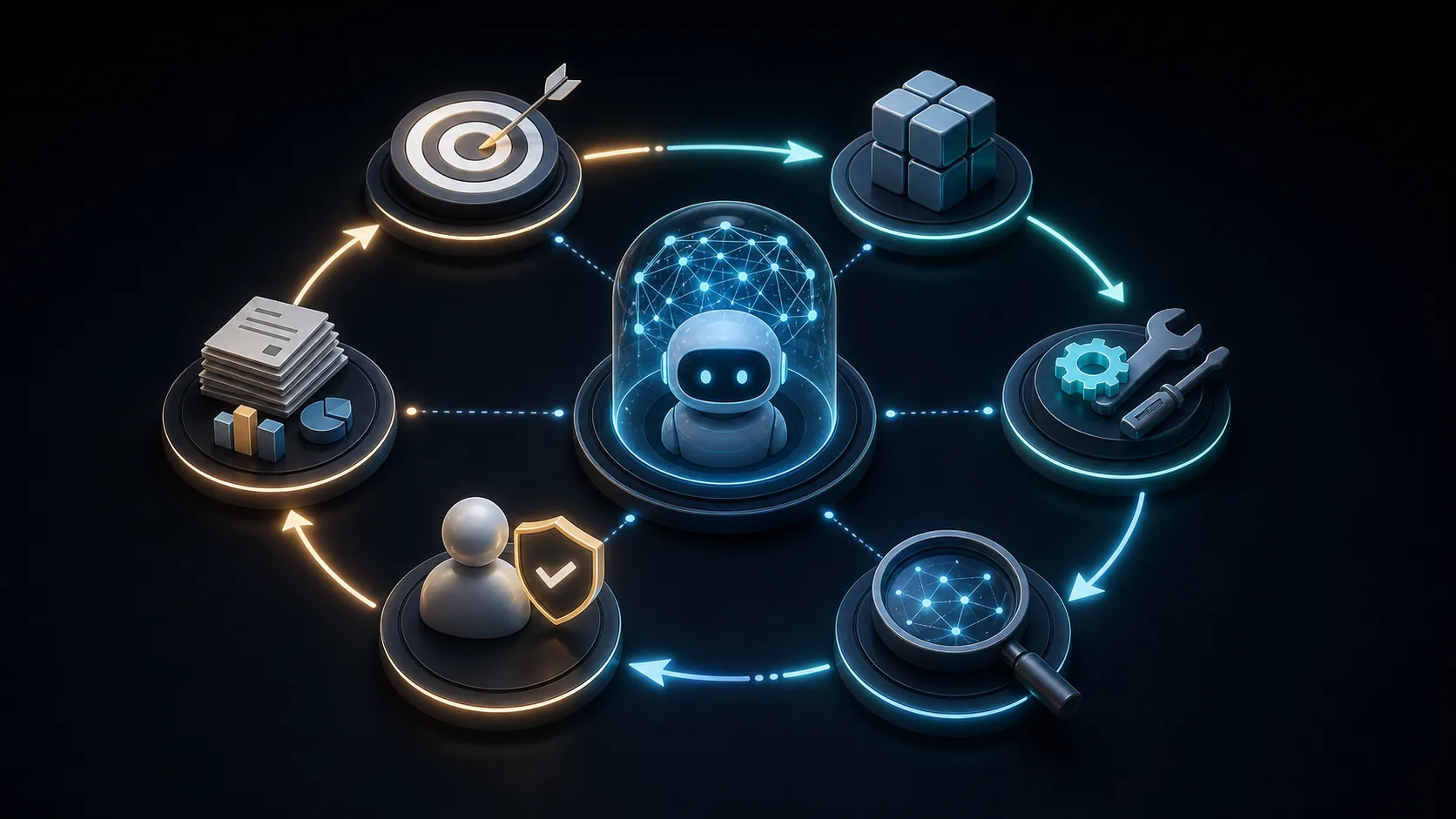
ANI (artificial narrow intelligence) is every AI system that exists in production today: powerful inside a defined task family, useless outside it. AGI (artificial general intelligence) describes a system that can learn and perform the full range of cognitive work a competent adult can do, including work it was never specifically trained for. ASI (artificial superintelligence) describes a system that outperforms the best humans across essentially all cognitive domains, including the work of improving AI itself. The three are not a staircase with clean steps. Research groups now describe capability as a grid of performance level crossed with breadth of domain, which is why a model can be superhuman at protein folding and below average at booking a dentist appointment. The practical test that separates the tiers is not IQ-style cleverness but sustained autonomy: how long a system can work on an open-ended task, in an unfamiliar environment, without a human catching its mistakes.
Why we needed three letters in the first place
The vocabulary is older than the current model boom. Turing’s 1950 paper sidestepped the question can machines think in favour of an operational test — could a machine hold a conversation indistinguishable from a person’s — precisely because the philosophical version had no resolution.[1] Seventy-six years later we are still doing the same trick: replacing an unanswerable question with a measurable proxy, then arguing about whether the proxy was any good.
ANI, AGI and ASI are that argument compressed into three acronyms. They are useful shorthand and terrible science. Useful, because they let a board, a regulator, and an engineer point at roughly the same disagreement. Terrible, because none of the three has a single agreed definition, a threshold test, or an accepted measurement procedure — and the marketing departments of at least four companies have a financial interest in the boundaries staying blurry.
So treat the tiers the way you would treat the words startup, scale-up and enterprise. Everyone knows what they mean. Nobody can tell you the exact headcount where one becomes the next. That does not make the words useless — it means you should ask what someone is actually claiming whenever they use one.
| Tier | Plain-English claim | Status in 2026 | Who uses the term most |
|---|---|---|---|
| ANI — narrow | Superhuman inside one task family, helpless outside it | Shipping everywhere, billions of daily calls | Engineers, product teams |
| AGI — general | Learns and performs most cognitive work a competent adult can | Contested; partial progress, no consensus it exists | Lab charters, policy documents, headlines |
| ASI — super | Beats the best humans at essentially everything cognitive | Hypothetical; no empirical instance | Safety researchers, philosophers, investors |
ANI: everything that actually runs in production
Artificial narrow intelligence is not a slur. It covers the spam filter, the fraud model, the chess engine that would beat every human who has ever lived, the protein structure predictor, the recommendation system, and — this is the part people resist — the large language model you used this morning. Narrow does not mean weak. It means the competence is bounded by a task family the system was shaped for, and the system has no reliable way to notice when it has left that family.
The tell is not error rate. It is error character. A narrow system fails in ways that reveal it never had a model of the goal, only of the surface pattern. It answers confidently outside its distribution, it cannot say I have no idea and I should stop, and it does not degrade gracefully. A human junior analyst who is out of their depth usually gets nervous first. Narrow AI gets fluent.
Modern language models complicate the picture, which is why the ANI label now generates arguments. A single model that writes SQL, translates Portuguese, drafts a contract clause, and reads a chest X-ray is plainly not narrow the way a chess engine is narrow. Chollet’s framing is the useful correction: intelligence should be measured as skill-acquisition efficiency over a scope of tasks, given priors and experience — not as the size of the skill set you can demonstrate.[3] A system with a very large stock of learned skills and a very poor ability to acquire new ones is broad, but still not general.
- Bounded competence: works inside a distribution shaped by training data and objective.
- No self-recognised limits: cannot reliably detect that it has left that distribution.
- Skill stock, not skill acquisition: breadth comes from having seen more, not from learning faster.[3]
- Fails fluently: confidence is unrelated to competence at the boundary.
AGI: six definitions that do not agree with each other
There is no canonical definition of AGI, and pretending otherwise is the single biggest source of bad AGI journalism. What exists is a family of definitions, each of which makes a different thing the essential ingredient. Below are the ones you will actually meet in documents that matter.
Notice what changes between rows. The economic definitions make AGI a labour-market fact — if it does the work, it is AGI, regardless of how, which is the shape OpenAI’s founding charter uses when it speaks of systems that outperform humans at most economically valuable work.[6] The cognitive definitions make it a learning fact — if it cannot acquire genuinely new skills efficiently, a huge skill inventory does not count. The risk-threshold definitions used in responsible-scaling policies sidestep generality altogether and ask only whether a capability crosses a danger line.[7] And the capability-profile definitions refuse a threshold entirely and give you a grid. These are not refinements of one another. They can be simultaneously satisfied and unsatisfied by the same system, which is exactly what is happening right now.
Legg and Hutter’s formal attempt is worth knowing about because it shows how hard the honest version is: they define universal intelligence as an agent’s expected performance across a weighted space of all computable environments, with simpler environments weighted more heavily.[2] It is mathematically clean, philosophically defensible, and completely uncomputable — you cannot run it on a Tuesday to check whether your vendor is telling the truth. Every practical definition since has been a trade of rigour for measurability.
| Definition style | The essential ingredient | Representative source | What it implies is missing today |
|---|---|---|---|
| Behavioural / imitation | Indistinguishable conversational performance | Turing, 1950 | Arguably already satisfied; widely judged insufficient |
| Formal / universal | Expected reward across all computable environments | Legg and Hutter, 2007 | Uncomputable; no practical test |
| Skill-acquisition efficiency | Learning new skills from few examples and weak priors | Chollet, 2019 | Sample efficiency and novel-task generalisation |
| Capability profile | Performance level crossed with breadth of domain | Morris et al., 2023 | Consistency of level across all domains |
| Economic / task-based | Outperforms humans at most economically valuable work | OpenAI Charter | Sustained autonomous completion of real jobs |
| Risk-threshold | Capability crossing defined danger thresholds | Anthropic responsible scaling policy | Deliberately not a general-intelligence claim at all |
The grid that replaced the finish line
The most useful reframing of the last few years came from a Google DeepMind team that argued AGI should be described as a matrix, not a milestone: one axis for performance level (emerging, competent, expert, virtuoso, superhuman) and one for generality (narrow versus general).[4] A chess engine is narrow-superhuman. A spell checker is narrow-competent. The interesting cells are the general column, and progress there has been genuinely uneven rather than uniformly advancing.
This grid explains the thing that confuses most people about 2026-era systems. A model can sit at narrow-superhuman on competitive programming, general-emerging on open-ended office work, and narrow-incompetent on tasks a nine-year-old finds trivial, all in the same forward pass. Averaging those into one number produces a headline and destroys the information.
The same paper makes a second point that deserves more attention than it gets: autonomy is a separate axis from capability. How much authority you hand a system is a deployment decision, not a property of the weights. A very capable model behind a read-only tool surface is a different risk object than a mediocre model with your production credentials, and conflating the two produces both bad safety policy and bad procurement.
| Level | Narrow examples | General examples | Honest 2026 read |
|---|---|---|---|
| Emerging | Simple rule systems | Frontier chat models on unfamiliar open-ended work | Where most general-purpose deployment sits |
| Competent | Spam filters, grammar tools | Contested — depends which task bundle you test | Reached in patches, not across the board |
| Expert | Medical imaging triage | Not demonstrated broadly | Claims here need per-domain evidence |
| Virtuoso | Chess, Go engines | Not demonstrated | No credible instance |
| Superhuman | Protein structure prediction, arithmetic | This is what ASI would mean | Hypothetical |
ASI: not AGI plus one, a different kind of object
Artificial superintelligence is usually defined as a system that substantially exceeds the best human performance in virtually every cognitive domain — including scientific creativity, strategy, and social skill. Bostrom’s widely used decomposition splits it into three forms that are worth keeping separate, because they have different failure modes and different plausibility.[5]
Speed superintelligence is a human-equivalent mind running much faster. Collective superintelligence is many human-equivalent minds coordinated well enough that the aggregate exceeds any individual. Quality superintelligence is a mind that is simply better in kind — the relationship a human has to a chimpanzee, not the relationship a fast human has to a slow one. The first two are extrapolations of things we can already partly build. The third is the one nobody knows how to reason about, and it is also the one that carries most of the risk argument.
The reason ASI is discussed seriously by people who are not science-fiction writers is the recursive-improvement argument: a system that is superhuman at AI research could improve itself or its successors, compressing development timelines in a way that removes the human oversight step. Whether that argument holds depends on empirical questions — whether AI research is compute-bound, data-bound, experiment-bound or idea-bound — and those questions have not been settled. The 2025 international expert assessment on advanced AI is a fair snapshot of how wide the credible range still is.[10]
- Speed: same quality of thought, orders of magnitude faster. Plausible, partially observable already.
- Collective: many coordinated instances outperforming any single mind. Being attempted now in multi-agent systems.
- Quality: categorically better reasoning. No evidence, no measurement procedure, most of the risk weight.
- The load-bearing claim in every fast-takeoff scenario is that AI research itself is the first domain to go superhuman.[10]
The measurement that actually separates the tiers
If you want one number to watch instead of a leaderboard, watch task time horizon: the length of a task, measured in how long it takes a skilled human, that a system can complete autonomously at some fixed success rate. METR formalised this and found that the horizon of frontier models had been doubling on a timescale of months rather than years — a trend line, not a law, and one whose extrapolation the authors themselves hedge heavily.[8]
Time horizon is a better tier separator than any accuracy score because it bundles the things that actually break in production: staying on goal, recovering from a failed step, noticing that the environment changed, and knowing when to stop. A system that answers any single question brilliantly but cannot sustain a four-hour task is narrow in the way that matters commercially, whatever it scores on a quiz.
The second measurement worth tracking is resistance to memorisation. ARC-AGI-2 exists specifically to be easy for humans and hard for systems that generalise poorly, with tasks designed so that pattern-matching against training data does not help.[9] The gap between human and machine performance on tests built this way is the closest thing the field has to a live readout on the general column of the grid.
| Signal | What it detects | Why it resists gaming | What a real jump would look like |
|---|---|---|---|
| Autonomous time horizon | Sustained goal-directed work | Cannot be memorised; failures compound | Multi-day tasks completed unsupervised |
| Novel-task generalisation | Skill acquisition, not skill recall | Tasks are unseen by construction | Human-level scores on freshly authored sets |
| Sample efficiency | Learning from few examples | Data volume cannot substitute | New domain learned from a handful of demos |
| Calibrated refusal | Knowing the edge of competence | Rewards saying no correctly | Reliable abstention outside distribution |
| Cross-domain transfer | Reuse of structure, not surface | Requires genuinely different domains | Physics insight improving legal reasoning |
Five confusions that make AGI conversations useless
Most AGI arguments are two people using one word for different things. These are the substitutions that cause it, and the correction that usually ends the argument in about ninety seconds.
| Common claim | What is actually being conflated | The correction |
|---|---|---|
| It passed the exam, so it is AGI | Skill demonstration with skill acquisition | Test on tasks authored after the training cutoff |
| It is conscious / sentient | Capability with phenomenal experience | Neither definition of AGI requires consciousness |
| AGI means mass unemployment | Technical capability with deployment economics | Diffusion, regulation and cost gate impact, not capability alone |
| It cannot be AGI, it makes silly mistakes | Average competence with worst-case competence | Humans also fail unevenly; the grid, not a threshold |
| We will know AGI when we see it | A measurable event with a social consensus | There is no agreed test; expect a decade of argument |
What any of this changes on Monday morning
Almost nothing you build should depend on which tier you believe we are in. What should change is how you write contracts, design oversight, and choose where to put a human. The useful question is never is this AGI. It is what is the largest unit of work this system can finish without supervision, and what does a silent failure cost me.
That reframing has a pleasant side effect: it is measurable this quarter. Take ten real tasks from your own workflow, define done, run the system unsupervised, and record the fraction it completes and the cost of cleaning up the rest. You will learn more about your AI strategy in a week than from any amount of tier debate — and you will have a baseline that stays meaningful when the next model ships.
Then design for the tier boundary you actually observe rather than the one on the roadmap. Keep authority explicit, keep actions reversible where you can, keep a log that a human can audit, and keep the ability to swap models without rewriting your business logic. Those four properties are good engineering under ANI and mandatory under anything stronger.
- Measure the unsupervised completion rate on your own tasks, not the vendor’s benchmark.
- Price the cost of a silent failure, because that number decides how much autonomy is rational.
- Keep authority separate from capability — permissions are a deployment choice.[4]
- Keep an auditable trace of every consequential action; retrofitting one is miserable.
- Stay portable across models, because tier arguments resolve slowly and model rankings do not.
Frequently asked questions
What is the difference between ANI, AGI and ASI?
ANI is narrow AI that performs well inside a bounded task family and cannot reliably tell when it has left it. AGI would learn and perform the broad range of cognitive work a competent adult can, including tasks it was not specifically trained for. ASI would exceed the best human performance across essentially all cognitive domains. Everything in production today is ANI by most definitions.
Are large language models AGI?
By the behavioural and economic definitions, some observers argue they partially qualify. By skill-acquisition definitions they do not, because their breadth comes from an enormous stock of learned patterns rather than efficient learning of genuinely new tasks. The honest answer is that different published definitions give different verdicts on the same system, which is why the question keeps repeating.
Is there an agreed test for AGI?
No. There is a family of proposals — imitation tests, novel-task suites such as ARC-AGI, economically valuable work criteria, and capability-profile grids — and no consensus on which one settles it. Expect the label to be contested long after the capability arrives.
Does AGI require consciousness?
No published definition in serious use requires consciousness or subjective experience. AGI definitions are about capability and generality. Consciousness is a separate philosophical question with no accepted measurement procedure.
How close is AGI?
Credible expert estimates span from a few years to several decades, and the spread reflects genuine disagreement about whether current methods scale to novel-task generalisation. Treat any confident single date, in either direction, as an argument rather than a finding.
What should a company actually track instead of AGI timelines?
Track the length and complexity of tasks your systems complete without human intervention, the unsupervised success rate on your own workload, and the cost of a silent failure. Those three numbers drive real decisions about autonomy; tier labels do not.
Sources and evidence
Primary and authoritative sources used for factual claims. Company research and executive forecasts are labeled as such in the article.
- 1Computing Machinery and IntelligenceMind, Oxford University Press · 1950-10
- 2Universal Intelligence: A Definition of Machine IntelligenceShane Legg and Marcus Hutter · 2007-12
- 3On the Measure of IntelligenceFrançois Chollet · 2019-11
- 4Levels of AGI: Operationalizing Progress on the Path to AGIGoogle DeepMind · 2023-11
- 5Superintelligence: Paths, Dangers, StrategiesNick Bostrom, Oxford University Press · 2014
- 6OpenAI CharterOpenAI · 2018-04
- 7Anthropic's Responsible Scaling PolicyAnthropic · 2023-09
- 8Measuring AI Ability to Complete Long TasksMETR · 2025-03
- 9ARC-AGI-2ARC Prize Foundation · 2025-03
- 10International AI Safety ReportUK Government and international expert panel · 2025-01