A vendor evaluation AI checklist for better buying decisions
Vendor evaluation is research, comparison, risk review, and decision memory in one workflow. AI can help, but only when the process keeps evidence and assumptions visible.
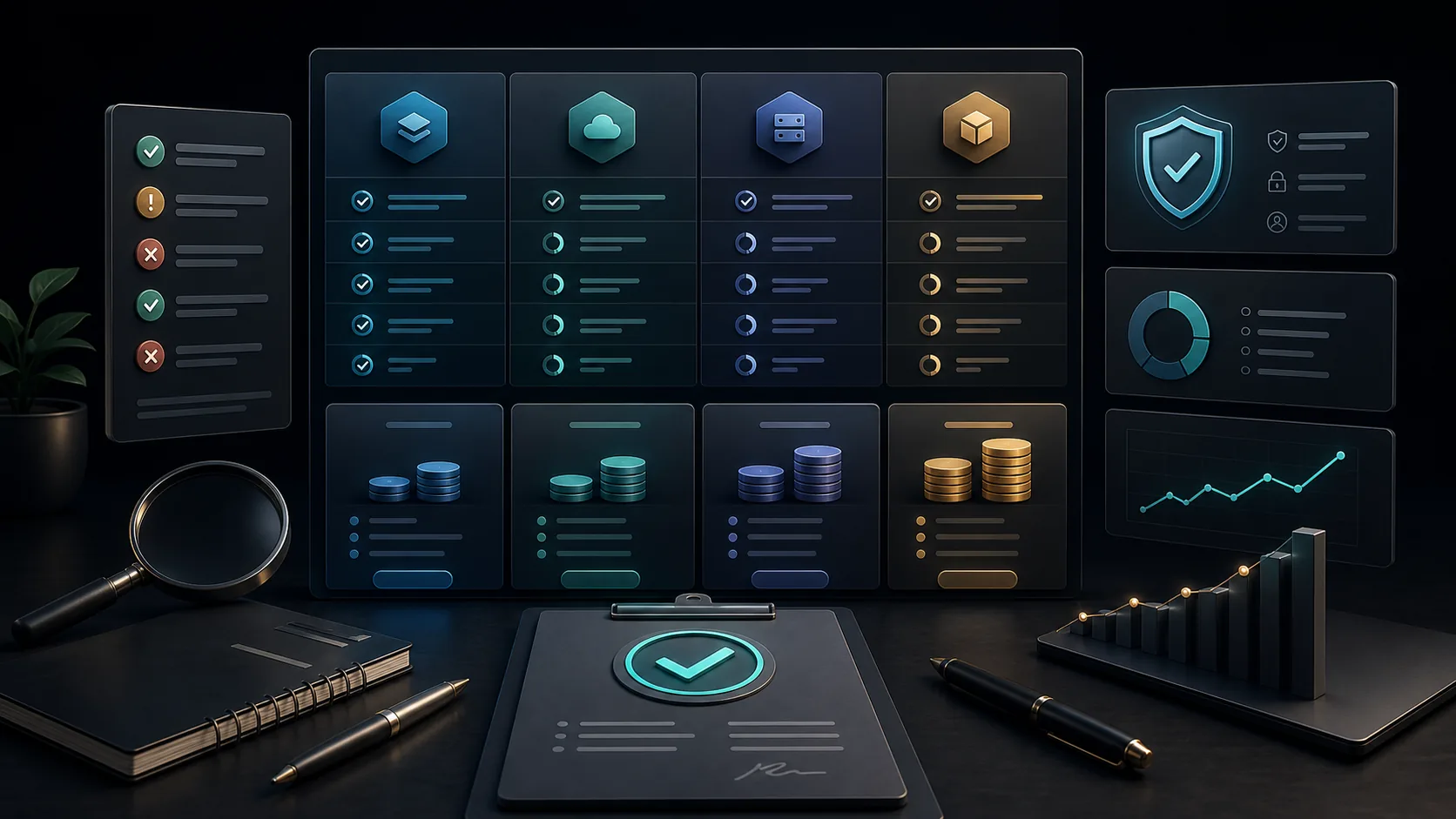
Why vendor evaluation needs structure
Buying decisions often happen under pressure. A team has a problem, a vendor has a polished story, and stakeholders need an answer quickly. Without a structured evaluation workflow, teams can overvalue demos, underweight implementation risk, and forget the assumptions behind the final decision.
An AI-assisted vendor evaluation should not simply rank vendors. It should help the team gather evidence, compare options against requirements, identify gaps, and preserve the decision trail for future renewals, audits, or stakeholder questions.
The checklist
- Problem fit: what problem are we solving, and is this vendor clearly aligned with it?
- Workflow fit: does the product match how the team actually works?
- Integration fit: what systems, APIs, identity providers, data stores, and operational tools must connect?
- Security posture: what claims exist around privacy, compliance, access control, audit logs, and data handling?
- Commercial model: what is known about pricing, packaging, usage limits, renewals, and expansion cost?
- Implementation risk: what setup, migration, support, training, or process change is required?
- Evidence quality: which claims are documented, demonstrated, customer-proven, or still unverified?
- Decision record: what did we choose, why, and what must be revisited later?
Evidence to collect
The strongest vendor evaluation combines public research, internal requirements, direct vendor answers, and customer or operational evidence. Product pages can explain positioning, but documentation and implementation details reveal whether the product can actually support the use case.
Teams should collect requirement docs, vendor pages, pricing notes, security docs, API references, integration guides, contract notes, sales call transcripts, demo notes, support requirements, and internal stakeholder feedback. Kendr can help turn those materials into a structured comparison.
Example Kendr prompt
Evaluate this vendor against our requirements.

Use the attached requirements, vendor docs, pricing notes, and security material.

Produce:
- fit summary
- feature and workflow gaps
- integration and implementation risks
- security and compliance questions
- pricing or packaging unknowns
- recommendation with confidence level
- follow-up questions for the vendor
This prompt pushes the output toward a decision artifact. It also makes open questions first-class, which is important because vendor evaluations often fail when unknowns are hidden inside a confident recommendation.
Decision matrix
A good decision matrix should be simple enough to use and specific enough to matter. Teams can score vendors across required capability, integration fit, security posture, implementation effort, cost confidence, support expectations, and strategic fit.
The matrix should also include a column for evidence quality. A high score based on a sales claim should not be treated the same as a high score backed by working docs, customer proof, and a successful pilot.
Security and compliance review
Vendor evaluation often becomes serious when security and compliance teams get involved. AI can help organize the evidence, but it should not invent assurances. The workflow should list what the vendor has documented, what is missing, and which claims require direct confirmation.
Important review areas include data retention, encryption, identity and access control, audit logs, sub-processors, regional data handling, export controls, incident response, business continuity, and administrative controls. For AI vendors, teams should also ask how customer data is used, whether training is involved, how prompts and outputs are retained, and what controls exist for sensitive information.
The output should separate "documented by vendor", "claimed in sales conversation", "validated by our team", and "unknown". That makes the risk posture much easier to discuss.
Pilot plan
A vendor pilot should test the riskiest assumptions, not the easiest demo path. If integration is the major risk, the pilot should connect to a real system. If adoption is the risk, the pilot should involve real users. If cost is the risk, the pilot should model actual usage volume.
Kendr can help turn the evaluation into a pilot plan with success criteria, required data, responsible reviewers, timeline, and go/no-go questions. This keeps the evaluation from becoming an endless research loop.
- Define what must be proven before purchase.
- Choose a realistic workflow and sample data set.
- Identify security and integration review gates.
- Record failure modes and user friction.
- Write the final recommendation while evidence is fresh.
Renewal and replacement value
The best vendor evaluation artifact becomes useful again at renewal. A year later, the team can compare original assumptions against actual adoption, cost, support quality, implementation effort, and product fit. This is why preserving the decision trail matters.
If a vendor underperforms, the original evaluation can reveal whether the issue was missed risk, changed requirements, weak implementation, or vendor execution. If the vendor performs well, the record helps justify renewal and expansion.
For replacement decisions, the old evaluation becomes a baseline. The team can ask what must improve, which switching costs matter, and what evidence a new vendor must provide.
Mistakes to avoid
Do not let the demo become the evaluation. Demos are useful, but they are designed to show the product at its best. The evaluation should test actual workflow fit, integration constraints, data handling, cost model, and implementation effort.
Do not treat every stakeholder preference as equal. Some requirements are hard constraints. Others are preferences. A structured AI workflow should separate must-have criteria from nice-to-have criteria.
Do not throw away the decision trail. Vendor decisions return during renewals, audits, security reviews, and implementation problems. Preserving the evaluation helps the team remember why the original choice made sense.
How Kendr helps
Kendr can keep vendor source material, comparison outputs, decision records, and follow-up questions in one workspace. That makes vendor evaluation easier to review and easier to reuse later.