CI/CD failure triage with AI
CI/CD failures are expensive because they interrupt flow. AI can help teams move faster when it reads logs, understands recent changes, identifies likely causes, and prepares safe next steps.
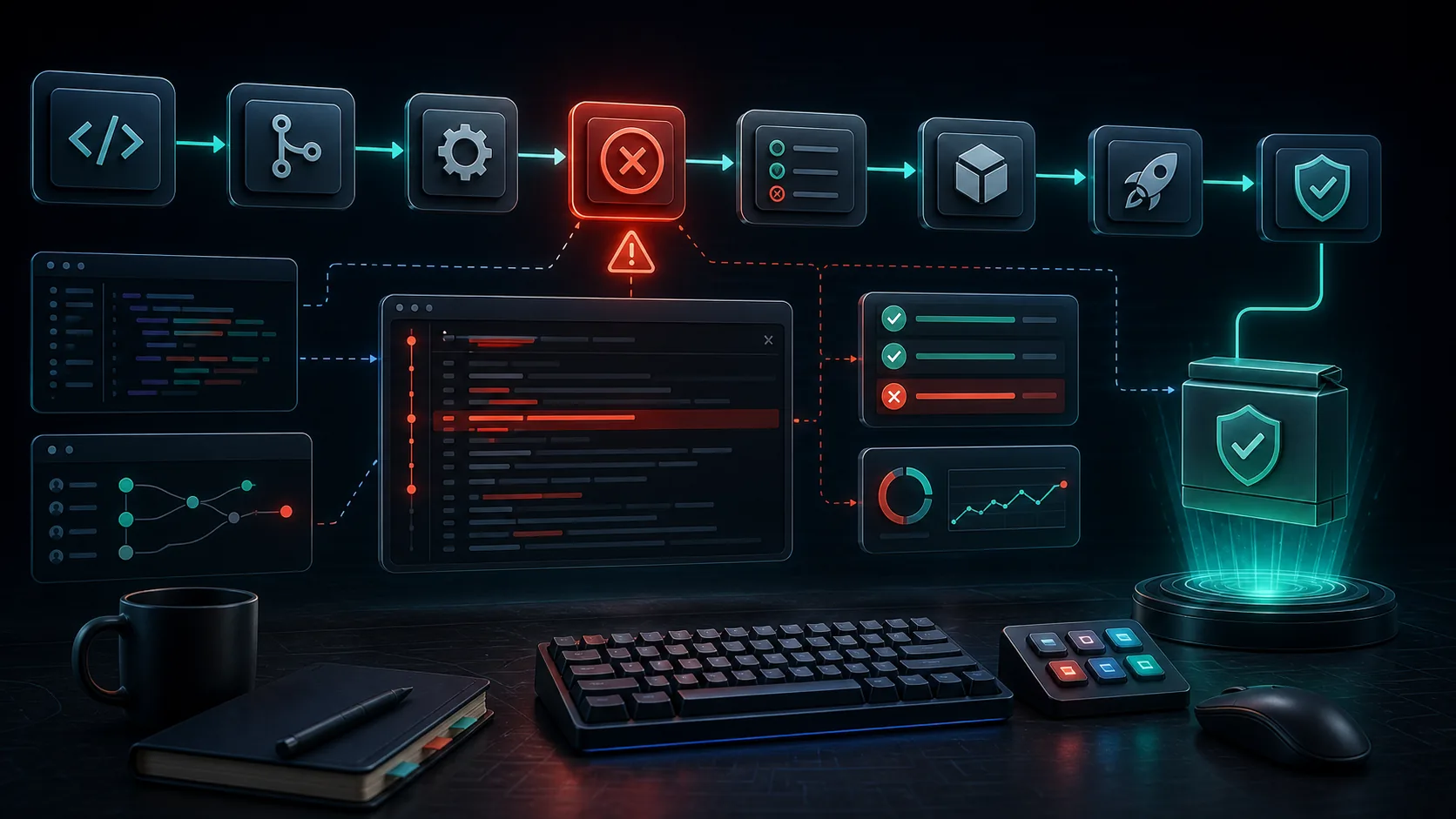
Why CI/CD triage is a good AI workflow
Build and deployment failures usually contain a lot of text and a small amount of signal. Logs, stack traces, test output, dependency warnings, container errors, and workflow metadata can be tedious to inspect manually. AI is well suited to compress that material into likely causes and next checks.
The workflow still needs discipline. The agent should not jump from a failed build to arbitrary code edits. It should first identify the failing stage, compare recent changes, isolate the likely cause, and explain the evidence.
What to collect
- Workflow metadata: branch, commit, job name, runner, environment, and triggering event.
- Failure logs: the first meaningful error, stack trace, failing command, and surrounding context.
- Recent changes: files touched, dependency updates, config changes, and environment changes.
- Test output: failing tests, flaky patterns, snapshots, coverage changes, and timeouts.
- Deployment context: image tags, release notes, migration steps, secrets, and target environment.
Good triage is not just log summarization. It connects the log to the change that probably caused it.
Example Kendr prompt
Triage this CI/CD failure.

Use the workflow logs, recent diff, package changes, and test output.
Do not edit files yet.

Return:
- failing stage and command
- first meaningful error
- likely root cause
- evidence from logs and code changes
- safe fix options
- when a human should review before applying changes
Triage categories
Most CI/CD failures fall into recognizable categories. Dependency failures happen when lockfiles, versions, packages, or registries change. Test failures happen when behavior changes or tests become brittle. Environment failures happen when secrets, paths, permissions, or runners differ from expectations. Build failures happen when compilers, bundlers, Dockerfiles, or generated assets break.
An AI workflow should classify the failure before proposing a fix. Classification helps the team choose the right reviewer and prevents broad changes when a narrow fix is enough.
Reading logs like an engineer
The first error in a log is not always the root cause, but it is often more useful than the final cascade of failures. A good triage workflow should identify the first meaningful error, the command that produced it, and the context around it. It should ignore repeated noise unless the repetition itself is the signal.
For tests, the assistant should distinguish assertion failures from setup failures, timeouts, import errors, fixture problems, and external service failures. For builds, it should distinguish source errors from dependency resolution, compiler configuration, environment differences, and generated artifact drift.
This is why recent changes matter. A log says what broke. The diff often explains why now.
Deployment readiness checks
CI/CD triage is connected to deployment readiness. A failing workflow may reveal that release checks are incomplete, environment assumptions are undocumented, or rollback steps are weak. Teams can use AI not only to fix the current failure, but also to improve the release process.
- Are migrations backward compatible?
- Are required secrets and environment variables documented?
- Are tests covering the changed behavior?
- Are generated assets committed or built consistently?
- Is rollback possible if deployment succeeds but runtime behavior fails?
- Do owners know which service or workflow they are responsible for?
When the agent should stop
Some CI fixes are safe to prepare but not safe to apply without review. The agent should stop before making broad dependency upgrades, changing deployment credentials, modifying production configuration, deleting tests to make a build pass, or rewriting large sections of code without a clear cause.
The best workflow produces a small, reviewable patch when the cause is clear. When the cause is uncertain, it should produce a triage note and recommended next checks instead of forcing a low-confidence fix.
Good triage output
A useful CI/CD triage output should be short enough for a busy engineer to act on, but complete enough that another reviewer can verify the reasoning. The best format starts with the likely cause, then shows the evidence, then lists options.
- Failure summary: workflow, job, command, and failing stage.
- Primary error: the first meaningful error and why it matters.
- Likely cause: the change, dependency, test, or environment issue behind the failure.
- Evidence: log lines, file changes, package changes, or configuration details.
- Fix options: smallest safe fix, broader fix, and when to involve a reviewer.
- Prevention: guardrail, test, or documentation update that would prevent a repeat.
From repeated failures to workflow memory
Repeated CI/CD failures are a signal that the team needs memory, not just fixes. If package installation fails every few weeks, the dependency process may need attention. If deployment checks fail because environment variables are missing, the release checklist may be incomplete. If tests are flaky, the team needs to preserve the pattern and decide whether to stabilize or quarantine them.
Kendr can preserve those patterns as project memory. That means future triage does not begin from zero. The agent can know that a service has fragile migrations, a package has caused lockfile conflicts before, or a deployment workflow requires a manual approval step.
From triage to fix
Once the cause is clear, the workflow can prepare a fix. For a simple test expectation mismatch, the next step might be a small code or test edit. For a dependency issue, the next step might be lockfile review. For deployment failure, the next step may require approval because production configuration or secrets could be involved.
Kendr's agentic workflow model is useful here because it can separate read-only investigation from side-effecting changes. The agent can propose the fix and explain risk before applying it.
Prevent repeat failures
CI/CD triage should improve the system over time. If the same class of failure repeats, the team may need better preflight checks, clearer error messages, dependency pinning, environment validation, or deployment guardrails.
Saving triage findings into project memory helps future workflows. The next time a similar failure occurs, Kendr can load known patterns, previous fixes, and release constraints before planning.
How Kendr helps
Kendr can connect repository context, workflow logs, agentic planning, skill packs, and project memory so CI/CD failure triage becomes a repeatable engineering workflow.