Agentic AI systems explained
Agentic AI systems use models, tools, context, memory, and control loops to pursue goals over multiple steps. The useful question is not whether an agent can act, but whether it can act with context and control.
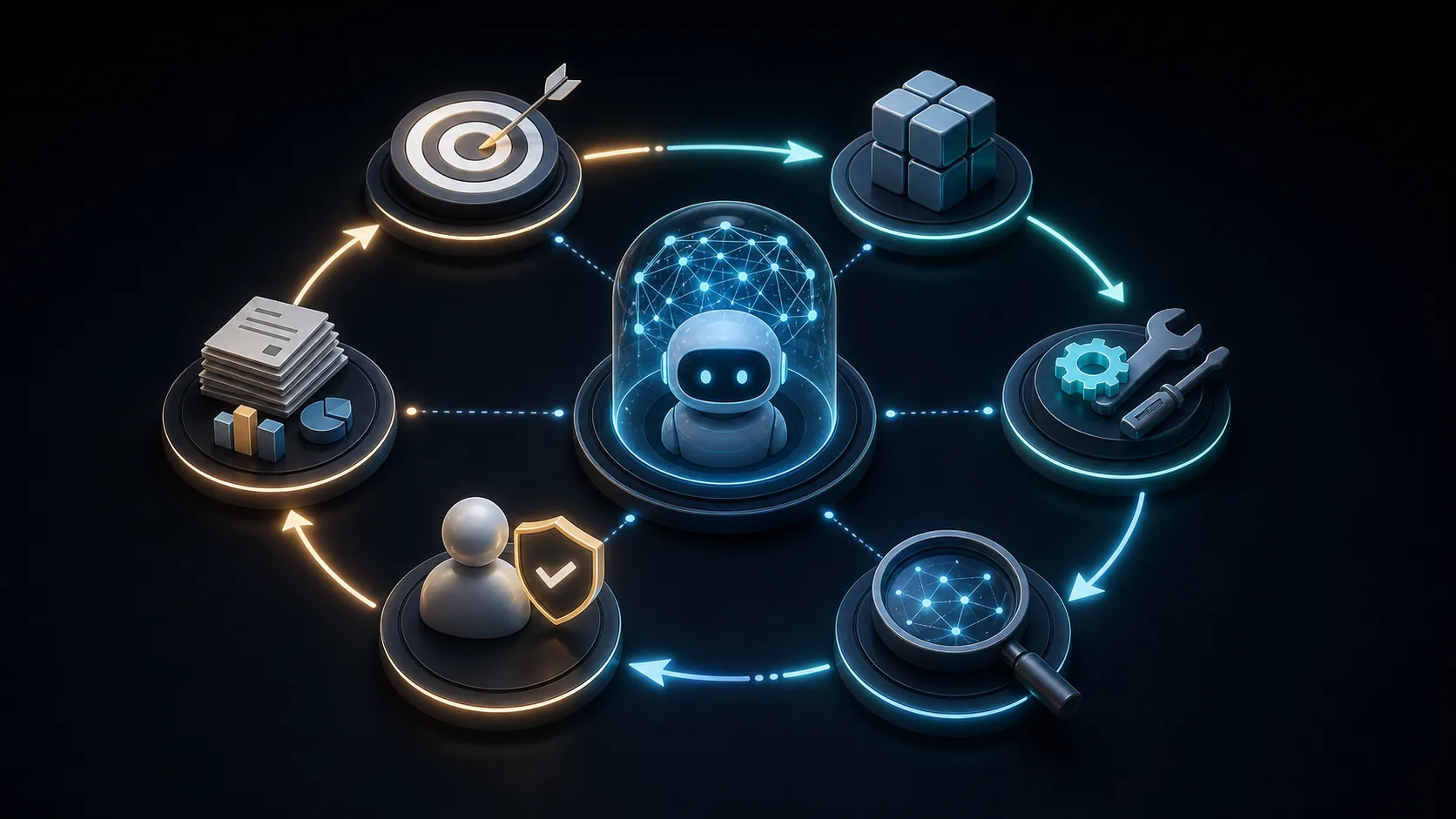
What makes AI agentic?
A normal AI interaction may answer a single prompt. An agentic system can break a goal into steps, call tools, inspect results, revise a plan, and produce an artifact. It may work across files, documents, APIs, repositories, browsers, calendars, cloud systems, or other agents.
Agentic does not mean fully autonomous. Many of the best systems are deliberately semi-autonomous. They can plan and prepare work, but they ask for human approval before risky actions.
Core building blocks
- Goal: what the user wants accomplished.
- Context: the information the agent needs to reason well.
- Planner: the mechanism that turns a goal into steps.
- Tools: actions the agent can call, often through protocols like MCP.
- Memory: retained knowledge from prior work.
- Control: policies, approvals, and limits around action.
- Evaluation: checks that determine whether the output is correct and useful.
Agentic workflow lifecycle
A healthy agentic workflow starts with intake. The system should understand the goal, environment, constraints, and output format. It then loads context, creates a plan, executes safe steps, pauses for approval when needed, and produces a reviewable artifact.
After the run, important findings should become memory. That is how agentic work improves over time. Without memory, the system keeps rediscovering the same project facts.
Levels of autonomy
Agentic systems can operate at different autonomy levels. At the lowest level, the agent only suggests next steps. At a moderate level, it can perform read-only investigation and draft artifacts. At a higher level, it can make local edits or call low-risk tools. At the highest level, it can make changes to external systems, but that level requires strong control, approval, and audit design.
Most teams should not start with full autonomy. They should begin with research, summarization, triage, planning, draft generation, and approval-gated actions. Trust grows when the system produces reviewable work.
Memory types
Agentic AI can use several kinds of memory. Short-term memory holds context for the current run. Project memory stores durable facts about a workspace, codebase, customer, vendor, or decision. Knowledge-base memory retrieves documents and source material. Procedural memory captures workflow patterns, prompts, and skill instructions.
Good memory design prevents repeated discovery and improves planning. Bad memory design can preserve stale or wrong assumptions. Teams need a way to update, scope, and review memory over time.
Tool use and observation
Agentic systems usually work through a loop: plan, act, observe, revise. The agent chooses a tool, receives a result, updates its understanding, and decides the next step. This loop is powerful, but it needs boundaries. Tool results should be structured where possible, and the agent should explain how observations changed the plan.
For high-risk domains, the loop should include explicit pauses. An agent can observe production state, but should stop before mutating production. It can draft a pull request, but should not merge without review. It can prepare a cloud command, but should ask before execution.
Where protocols fit
MCP helps an agent access tools and resources. RAG helps the agent retrieve knowledge from documents and source material. A2A helps agents communicate with other agents. ACP-style controls help decide whether an agent action should be admitted before execution.
These concepts solve different parts of the same larger problem: how to make AI systems useful in real work without losing control, context, or accountability.
Evaluation questions
- Did the agent understand the actual goal?
- Did it load the right context?
- Did it make a visible plan?
- Did it use tools safely and correctly?
- Did it stop before risky actions?
- Did it produce a reviewable artifact?
- Did the workflow save reusable memory?
Agentic AI in Kendr
Kendr is designed around research-to-execution work. A user can research a topic, build a knowledge base, use skills and MCP tools, and move into controlled agentic workflows. The product value is not raw autonomy. It is context-rich execution with a clear path back to evidence and approval.
Continue with agentic workflows for teams or AI agent protocols compared.
Frequently asked agentic AI questions
Is an agent just a chatbot with tools?
Tools are part of the story, but an agentic system also needs goals, planning, observation, memory, and control. A chatbot can answer. An agentic workflow can pursue a task over multiple steps.
What makes agentic systems risky?
Risk increases when agents can affect external systems, use sensitive data, or operate for many steps without review. That is why approval, logging, scoping, and evaluation matter.
What is a good first use case?
Good first use cases are high-context but low-risk: research briefs, CI triage, architecture review, vendor comparison, document analysis, and draft plans that humans review before execution.
How to apply agentic AI thinking
Pick workflows where the agent can create a valuable artifact before it needs permission to change anything. A research brief, triage report, risk register, plan, checklist, or pull request draft gives the team something concrete to review.
Then add more autonomy only where the system has enough context, evaluation, and control. Good agentic AI adoption is gradual, observable, and grounded in work people already understand.